
US-Iran Peace Talks: A predicable breakdown

Updated: Jul 28
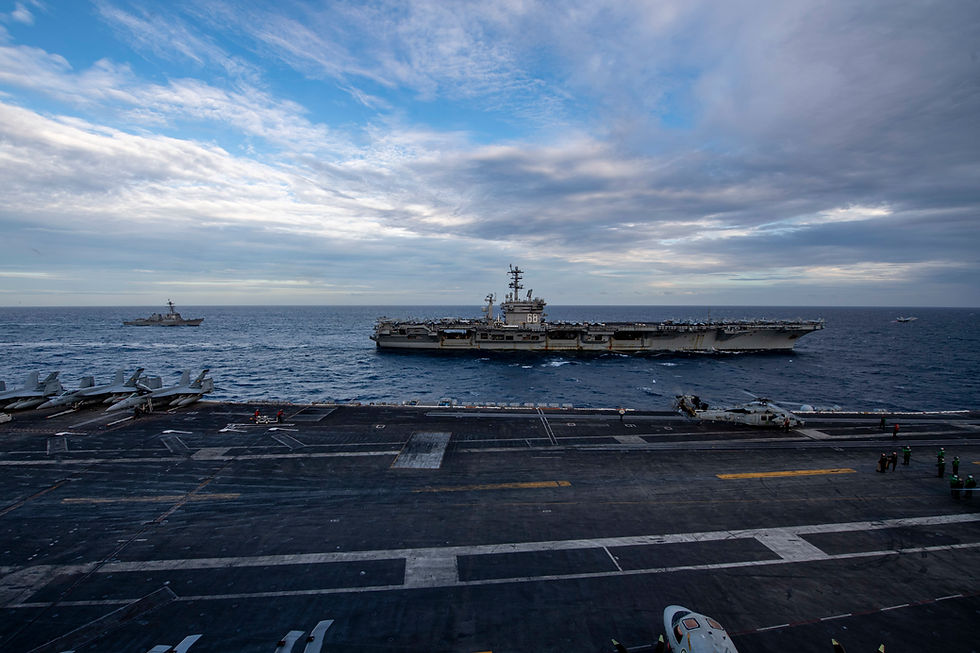
The much-anticipated truce talks between the United States and Iran broke down on Sunday. The war, raging since February 28 and which engulfed the entire Middle East and closed a critical global shipping route, now appears to be far from over with both sides using a convenient but temporary détente to arm up and prepare for the next round of missile exchanges.
The joint US-Israeli military operation, launched on February 28 to eliminate Iran's leadership, destroy its military and prevent the country from developing nuclear weapons has reached a hard-fought stalemate six weeks into the battle.
Prologue: The US-Israeli air campaign
The air campaign achieved stellar successes in the first month of the battle. The sheer weight of the US carrier strike force, USAF formations stationed in the Middle East and the Israeli Air Force eliminated Iran's supreme leader Ayatollah Ali Khamenei, his successor Mojtaba Khamenei, prominent politician and security chief Ali Larijani, Basij force commander Gholamreza Soleimani and Alireza Bayat, the deputy head of security for Iran's Supreme National Security Council.
US and Israeli air strikes and precision bombings also took down Ali Shamkhani, secretary of the Iranian Defence Council, Mohammad Pakpour, the commander-in-chief of the Iranian Revolutionary Guard Corps, Abdolrahim Mousavi, the armed forces' chief of staff, defence minister Aziz Nasirzadeh, intelligence minister Esmail Khatib, Majid Khademi, the head of IRGC intelligence, and IRGC Navy chief Alireza Tangsiri.
Having eliminated the prominent leaders, the US and Israeli forces went for Iranian facilities reportedly used to enrich uranium or develop nuclear weapons. Heavy and precise airstrikes evaporated or damaged facilities like the Khondab Heavy Water Complex, Bushehr Nuclear Power Plant, Ardakan Yellowcake Production Plant, and Natanz Nuclear Facility.
The campaign also entirely eliminated whatever remained of the Iranian Navy and heavily damaged the Parchin military complex reportedly used to develop chemical weapons, liquid-fueled ballistic missiles, laser enrichment technology and high explosives for nuclear weapons. The Malek Ashtar University nuclear research facility, the Choqa Balk-e drone base, the Quds Force base, IRGC headquarters, ten Ministry of Intelligence command sites, the presidential compound and major steel factories were reportedly destroyed.
Iranian response
Iran responded immediately to the coordinated airstrikes despite losing critical military facilities and top leaders in the first days of the war. Over the course of the next month, the Iranian response was marked by large-scale drone and missile strikes that gave Western policymakers a glance at the depth and range of Iranian military reserves conserved for a war of massive proportions.
The Iranian response wasn't restricted to targeting US air power. The military launched missile and drone attacks at prominent US military bases scattered all over the Middle East and facilities that housed US troops. The targeted facilities included the Al Dhafra Air Base in the UAE, the US Fifth Fleet headquarters in Bahrain, military bases in Iraq, Qatar, Kuwait, and the UAE, and US air-defence and satellite-communication systems in Jordan. The most eye-catching event was the destruction of a $300 million U.S. AN/TPY-2 radar system in an air base in Jordan.
Iranian missile strikes and air defence operations also destroyed a Boeing KC-135 Stratotanker, a Boeing KC-46 Pegasus refueler, a Boeing E-3 Sentry AWACS aircraft, multiple long-range Israeli drones, over a dozen MQ-9 Reaper UAVs, each costing about $30 million, five USAF Boeing KC-135 Stratotankers stationed at Prince Sultan Air Base in Saudi Arabia, an F-35 Lightning II over Iran, an F-15E Strike Eagle jet, Black Hawk helicopters, two C-130 Hercules transport aircraft, and a Northrop Grumman MQ-4C Triton UAV.
In response to US-Israeli strikes on multiple oil refineries and gas production facilities, Iran struck energy facilities all across the Middle East, including oil fields, refineries, ports and gas plants in Qatar, Saudi Arabia, the UAE, Bahrain, and Oman. Missile strikes on Qatar's Rasgas 2 and Rasgas 3 LNG facilities were particularly destructive, with Qatar announcing that 17% of the Ras Laffan Industrial City's gas production went offline and repairs could take up to five years.
According to analysis by JP Morgan Commodities Research, Iran completely destroyed Bahrain's Sitra Refinery which contributes 11% to the country's economy, and the Habshan Complex which produces 60% of the UAE's domestic gas. Further missile and drone attacks in the UAE significantly damaged the Fujairah oil hub, Ruwais refinery, and Emirates Global Aluminium facilities. In Saudi Arabia, the East-West pipeline, the Jubail industrial complex, and the Manifa/Khurais production facilities suffered significant hits.
A major share of Iran's revenge attacks was directed at Tel Aviv. Tehran reportedly fired about 650 missiles at Israel, killing twenty people and injuring over 7,000. A major share of the missiles fired by Iran carried cluster bombs that dispersed over a wide range before exploding.
Iran's vice grip on Hormuz
The most significant fallout of the prolonged conflict was its impact on ship movements in the Strait of Hormuz, a 104-mile long vital sea corridor between the Persian Gulf and the Gulf of Oman navigated byh more than a hundred cargo ships cross every day.
The US military campaign against Iran since late February had a significant naval component. The US Navy moved the USS Abraham Lincoln carrier strike group to the Persian Gulf in January. In early April, the USS George HW Bush carrier strike group, including USS Ross, USS Donald Cook, and USS Mason - all Arleigh Burke-class destroyers - entered the gulf after the Navy withdrew the Gerald R Ford carrier for urgent repairs.
The powerful armada, along with its large air wing, destroyed the Iranian Navy in detail, with a Los Angeles-class submarine travelling as far as southern Sri Lanka to sink IRIS Dena which was returning from a naval exercise in India. The attacks sent insurance premiums for ships crossing the Strait of Hormuz soaring. Iran's announcement that it would stop US-linked cargo movements on the Strait further slowed the rush of cargo ships into a trickle.
The war carried on for forty days, thanks to Israeli and American assessment that the death of top Shia leaders and the degrading of IRGC will make the Iranian people rise up in revolt. They never did, leading an enraged Trump to threaten to cut off ties with NATO (for their lack of support), mock President Macron, mock Prime Minister Keir Starmer, promise to destroy an entire civilisation and eventually cut off the Strait of Hormuz to prevent Iran from collecting toll from ships crossing the channel.
The brief détente
With Iran displaying little sign of fatigue or degradation of its drone or missile inventories, Trump announced a two-week ceasefire on April 8. Iran quickly responded to the gesture, launching missile strikes all across the Gulf and at Israel, claiming the latter's attack on Lebanon as a ceasefire violation. Israel continues to bomb and flatten Lebanon, aiming to destroy Hezbollah once and for all, and possibly to defer corruption proceedings against Prime Minister Netanyahu.
Trump's announcement, however, led to a thaw soon after as US and Iranian leaders agreed to negotiate a permanent ceasefire. The talks were held in Pakistan's capital Islamabad amidst much pomp and show, and predictably led to a failure. Trump blamed Iran for the breakdown, announcing that the US Navy will blockade the Strait of Hormuz for all traffic with immediate effect.
Reports indicate that Trump was egged by Saudi crown prince Mohammed Bin Salman to end the ceasefire and finish Iran for good. MBS allegedly promised hundreds of billions in investments into the US economy, normalisation of ties with Israel, purchase of $500 billion worth of arms from the US, creation of a joint naval force to guard the Strait, and setting up of a reconstruction fund to rebuild a democratised Iran.
Iranian media has alleged that a call from Prime Minister Netanyahu to vice president JD Vance, who led the US negotiating team in Islamabad, led to the breakdown of talks. According to the White House, the talks broke down as Iran refused to stop developing nuclear weapons or stop supporting the Hamas and the Hezbollah. Israel, a prominent player in the war, ought to have been part of the negotiating team, but Iran possibly wouldn't have it, nor would Pakistan, the summit host, for political reasons.
The crusades are back
The US-Israel-Iran war has severely impacted global trade and energy security on both sides of the Strait of Hormuz. The Middle East is on fire, Israel is no closer to finishing its expanding post-October 7 objectives, and a large number of major nations dependent on Middle Eastern oil and gas supplies are being forced to open up their strategic reserves.
All this thanks to the utter failure of the United Nations as a global institution committed to peace and cooperation. The UN has been missing in action all through the conflict, enabling primitive tribal instincts to dictate the rules of the planet yet again.
The US-Iran conflict is essentially the climax of a simmering feud between a local gangster using his henchmen and safety of the mountains to bully and terrorise the region into submission, and a global warlord intent on preserving its military and financial dominance over West Asia and the Middle East.
The war is being fought in the 21st century, but the emotions fueling it are as old as the ones that triggered the Byzantine–Ottoman wars and the religious crusades that lasted three centuries.
For the Iranian regime, Israel is nothing but an illegal Jewish settlement squatting on Palestine territory and Jerusalem - one that must be eradicated by all means necessary, including nuclear weapons. For the Trump regime, Israel is the powerful regional warlord that maintains its military dominance and keeps its foes at bay.
With the Ayatollah gone and his successor yet to appear in public, Donald Trump has assumed the role of the sole power in the region. He has treated carnage in the Middle East as a small distraction, and lambasted "dependent allies" in Europe for not joining his crusade to solidify Israel's hold over Palestine while dreaming big about getting his hands around Iranian oil just like he got them around Venezuela's.
The Pakistani circus that did no favours to the world
Trump's escalation theatrics amidst the Middle Eastern carnage and a resulting global energy crisis provide a sombre reminder of what absolute power can do. The energy crisis doesn't bother him, and he has gone on record to boast that the US, self-sufficient in oil and gas, will sell more of its volumes as oil fields, basins, refineries and storage sites in other countries are either taken over, sanctioned or set on fire.
The politics on either side of the present war isn't lost on anyone, especially in the Middle East. Neither Saudi Arabia, the UAE, Oman, Bahrain or even Turkey volunteered to mediate a settlement, for such a settlement would only cater to US regional interests and only boost the petrodollar.
Despite the obvious motives, a ceasefire would suit the world. The Strait of Hormuz is as critical to global trade as Middle Eastern oil and gas are to keep nations functioning. With costs of war soaring and domestic approval ratings plummeting, Trump signalled a desire to end the war to great relief of all involved.
In comes Pakistan, a failed state with significant international debt, widespread poverty, an army that runs the government, and an oasis of civil wars and Islamic radicalisation. Yet, a nation that has a strong geopolitical role to play in supporting US interests in the region. Trump chose Pakistan, yet again, to play the role of a scapegoat who negotiated a ceasefire between the two countries, only for it to fall apart soon after.
For the failing state which faces multiple secessionist movements that are growing stronger, the news of a possible mediatory role to end the global crisis arrived as cause for jubilation - one that required locking down the capital city, repainting the roads, unleashing social media campaigns with self-congratulatory messaging, and casting itself as the world's saviour.
The planned talks, named #IslamabadTalks with much narcissistic fanfare, saw US vice president JD Vance, Trump's son-in-law Jared Kushner and Special Envoy Steve Witkoff land in Islamabad on April 11, engage in a 21-hour negotiation with Iranian representatives, and fly out immediately with both sides blaming each other for the failure. Pakistan's role in the sorry affair ended, and so did the self-congratulatory social media campaigns.
The failed negotiation, planned and executed by Trump and his advisors, possibly infuriated the President to no end. Trump quickly blamed the Iranians and soon after, threatened to use his all-powerful Navy to enforce a total blockade of the Strait of Hormuz.
At the time of writing, the US Navy is shifting more assets to the Persian Gulf to carry out the President's orders. With the president's motives being unpredictable, it is unclear if he wants to push the world into chaos or threaten significant action to force Iran to make concessions. With the United States' NATO allies refusing to participate in the enforced blockade, the latter plan seems dead on arrival.


Comments